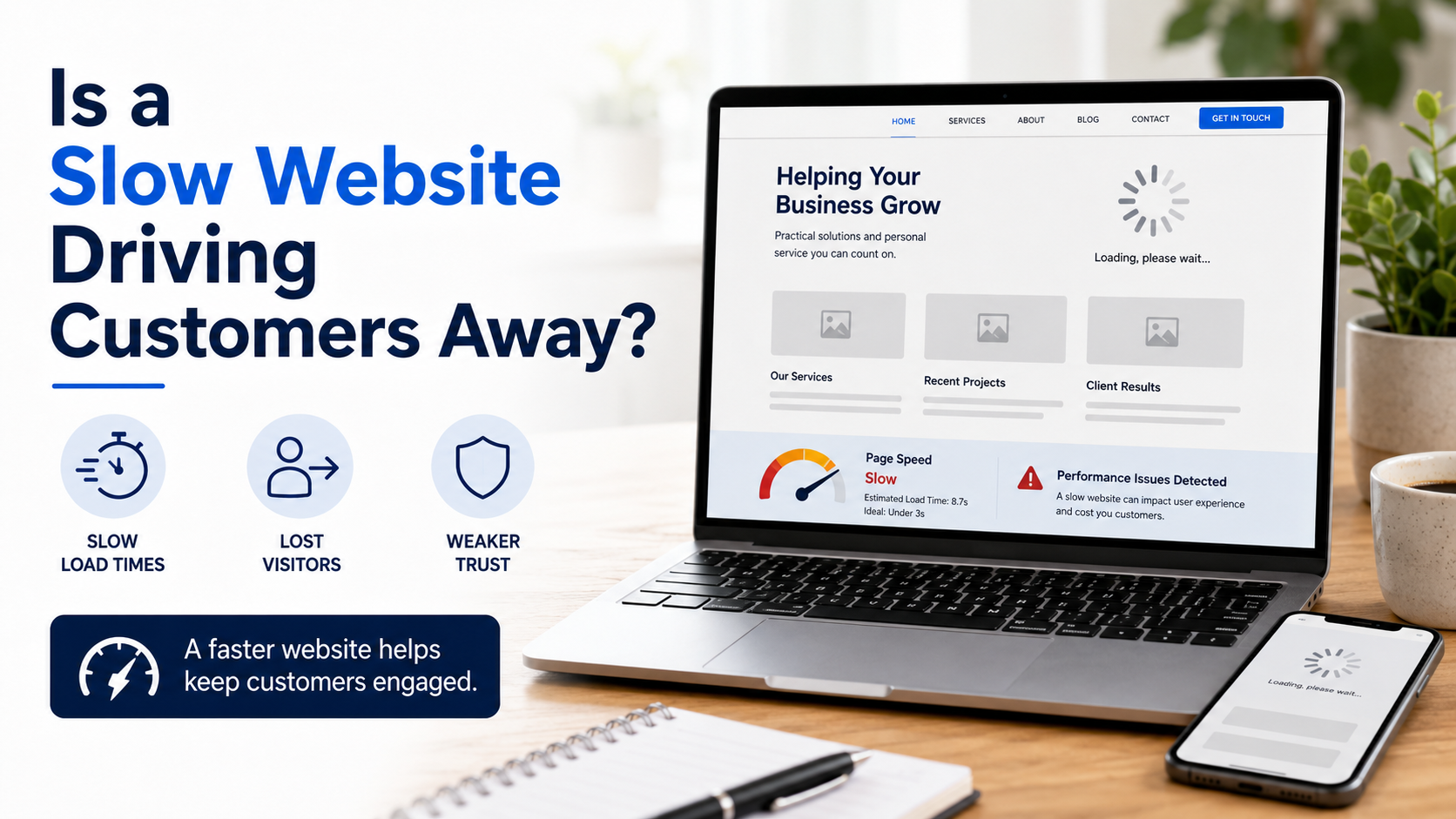

3. Is a Slow Website Driving Customers Away?
A slow website can create problems before a visitor ever reads about your services.
When pages take too long to open, images appear slowly, or buttons do not respond immediately, potential customers may leave before learning what your business offers.
Most visitors do not know why a website is slow. They only know that it is not working the way they expected.
What Can Make a Small Business Website Slow?
Website performance can be affected by several issues, including:
Large, uncompressed photographs
Multiple videos loading on the same page
Unnecessary animations
Excessive third-party tools or tracking scripts
Poorly optimized mobile layouts
Older website templates
Complicated page designs
Features that are no longer being used
Small-business websites frequently rely on photos to display completed work, products, food, facilities, or services. These images are important, but uploading extremely large files without properly preparing them for the website can significantly affect performance.
The solution is not necessarily to remove the photos. They may simply need to be resized, compressed, reorganized, or loaded more efficiently.
Website Speed Affects Customer Confidence
Visitors often associate website quality with business quality, even when the two are not directly connected.
A slow or unresponsive website can make a professional business appear outdated. It can also make basic actions—such as viewing a service page, opening a gallery, or submitting a contact form—feel unnecessarily difficult.
For customers searching from a mobile phone, these problems may be even more noticeable.
Someone trying to request an estimate or check whether you serve their location should not have to fight their way through the website like it is the final level of a video game.
Can an Existing Website Be Made Faster?
In many cases, yes.
Improving website speed may involve optimizing images, simplifying crowded sections, removing unnecessary features, improving mobile formatting, or rebuilding individual pages that are causing problems.
However, some older websites may have broader structural limitations. In those cases, repeatedly patching the existing design may be less effective than creating a cleaner replacement.
Shift Arrow Group LLC helps small businesses identify what may be slowing down their websites. We focus on practical improvements and explain whether the existing website can be optimized or whether a redesign would provide better long-term value.
If your website feels slow, inconsistent, or difficult to use, contact Shift Arrow Group LLC for a review of its current performance.
Related article: Read “5 Signs Your Small Business Website Needs an Update” for a broader look at common website problems.