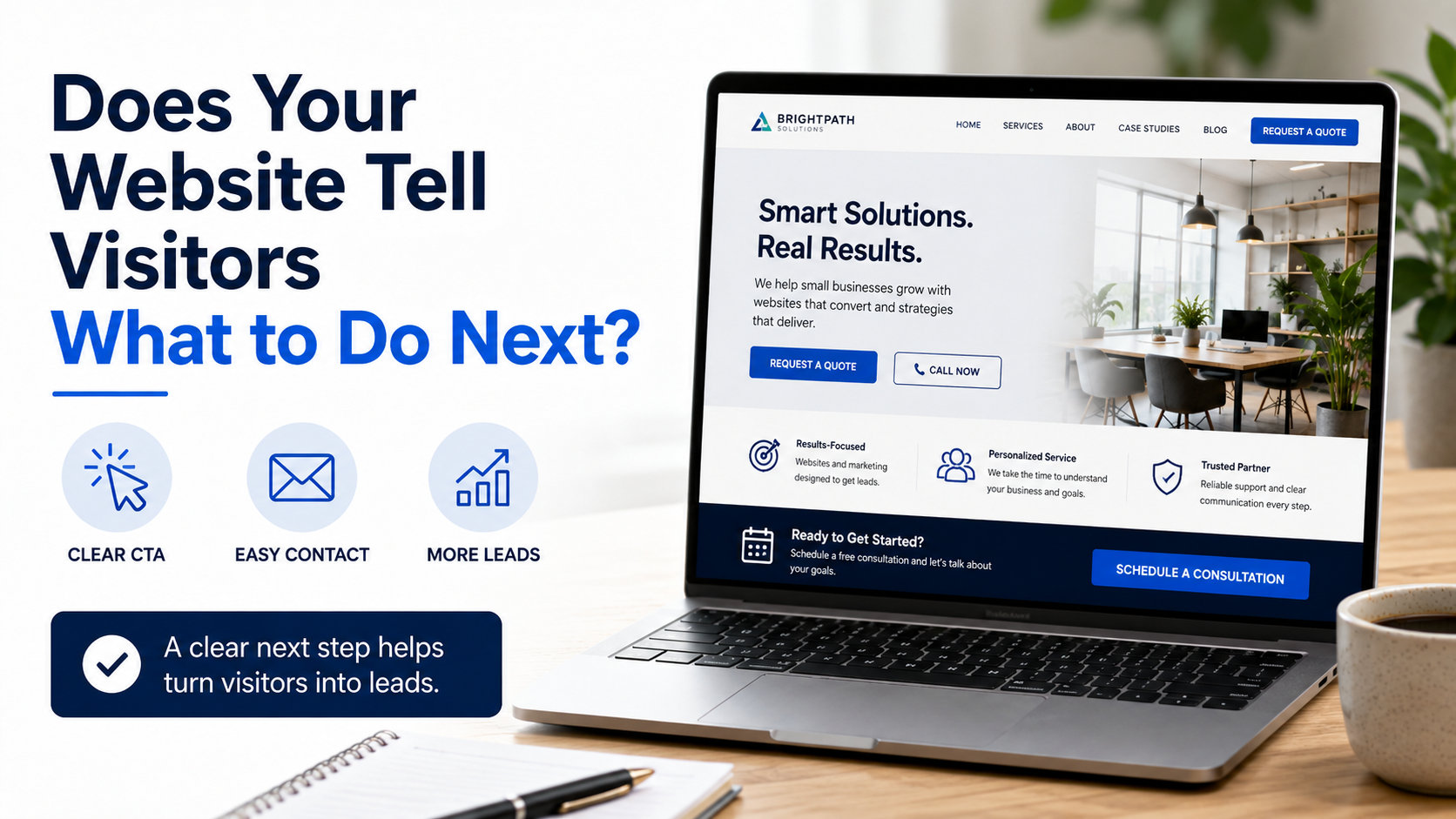
4. Does Your Website Tell Visitors What to Do Next?
A potential customer visits your website, looks at your homepage, reads about your services, and views a few photographs.
Then what?
If the website does not clearly tell the visitor how to take the next step, that person may leave without calling, requesting an estimate, booking an appointment, or visiting your business.
This is where a clear call to action becomes important.
What Is a Call to Action?
A call to action is a button, link, or short statement that guides visitors toward a specific step.
Examples include:
Request an Estimate
Schedule a Consultation
Call Now
View Our Services
See Our Work
Book an Appointment
Contact Our Team
Get Started
A call to action does not need to be aggressive or overly promotional. It simply needs to make the visitor’s next step clear.
Every Page Should Have a Purpose
Different website pages may require different calls to action.
A service page might encourage the visitor to request an estimate. A gallery might direct them toward a contact form after they review previous work. A restaurant page might encourage them to view the menu, check hours, or get directions.
The homepage may contain more than one option, but it should still prioritize the action that matters most.
When too many buttons compete for attention, the website can become confusing. When there are no visible buttons at all, visitors may not know where to go.
The strongest website layouts create a natural path:
Introduce the business.
Explain the service.
Build confidence.
Make the next step easy.
Contact Forms Should Be Easy to Use
A contact form should request enough information for the business to respond without feeling like a twelve-page government application.
For many small businesses, a name, email address, phone number, service needed, and short project description may be enough to begin the conversation.
The form should also work properly on mobile devices and provide confirmation after it has been submitted.
Improving Calls to Action
Adding more buttons is not always the answer. Placement, wording, page structure, and mobile usability all matter.
Shift Arrow Group LLC helps small businesses create clearer website paths that guide visitors from learning about the company to making contact. This may include improving button placement, simplifying contact forms, reorganizing page content, or strengthening service descriptions.
The goal is not to pressure visitors. It is to remove confusion and make contacting your business easier.
If customers are visiting your website but not reaching out, Shift Arrow Group LLC can help review whether the website clearly communicates what they should do next.
Related article: Read “5 Signs Your Small Business Website Needs an Update” to identify other issues that may affect customer inquiries.